The Invisible Variable in Heat Treatment
In material science, we obsess over precision. We control alloys to parts-per-million and measure tolerances in microns. Yet, in traditional heat treatment, we often ignore the most pervasive variable in the room: the air itself.
The atmosphere is a chaotic mixture of reactive gases. At high temperatures, the oxygen we breathe becomes an aggressive agent, bonding with metal surfaces to form an oxide layer, or scale. This isn't just a cosmetic issue; it's a fundamental alteration of the material's surface and a gateway for contamination.
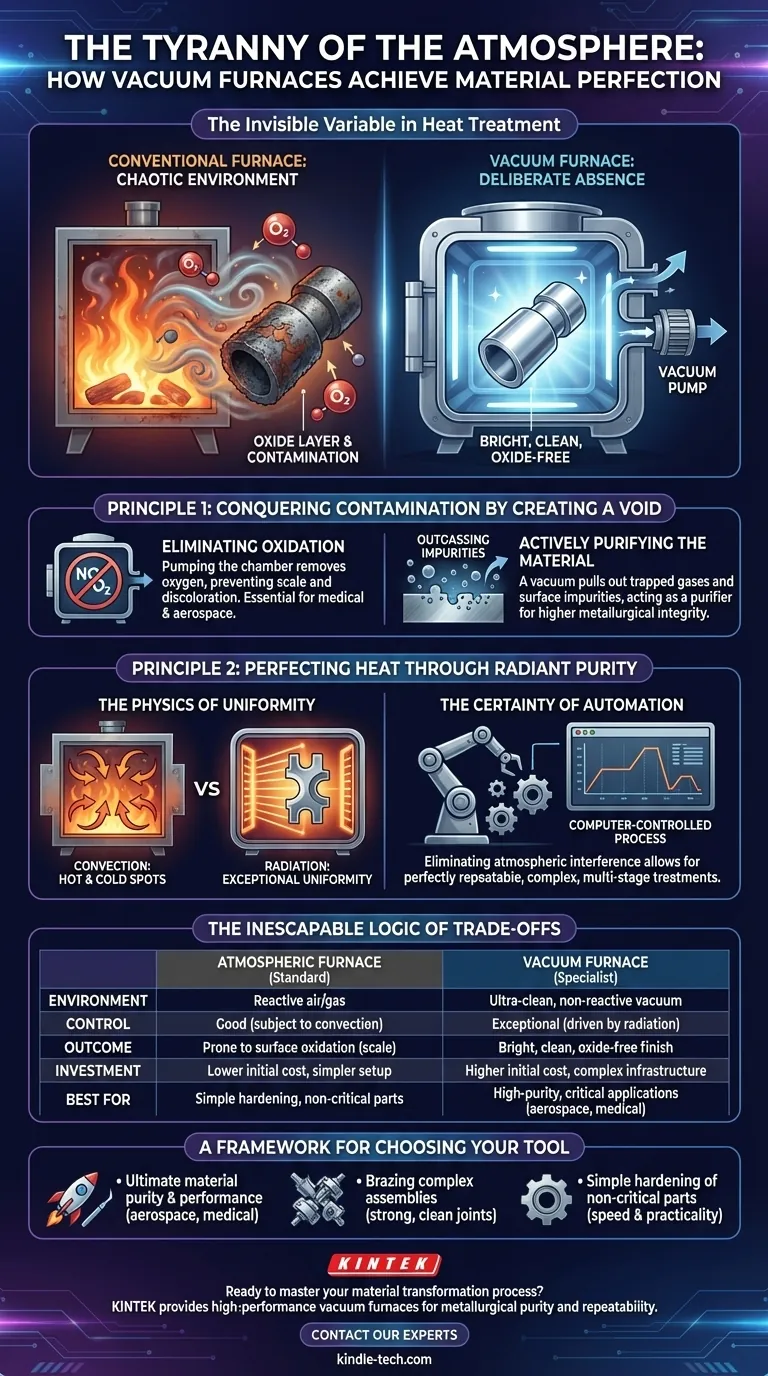
A conventional furnace operates within this chaotic environment. A vacuum furnace, however, operates on a principle of deliberate absence. It doesn't just heat a component; it first isolates it from the world.
Principle 1: Conquering Contamination by Creating a Void
The core purpose of a vacuum furnace is to remove the atmosphere, thereby removing the primary source of process uncertainty.
Eliminating Oxidation
By pumping the chamber down to a near-perfect vacuum, we remove the oxygen. This simple act is transformative. Components emerge from the furnace bright, clean, and free of discoloration.
This isn't merely an aesthetic benefit. For applications like medical implants or aerospace components, an oxide-free surface is a non-negotiable requirement for performance and safety. It ensures the material's inherent properties remain unchanged.
Actively Purifying the Material
A vacuum doesn't just prevent contaminants from entering; it actively pulls them out. As a material is heated, it can release trapped gases and surface impurities—a process known as outgassing.
The vacuum system acts as an exhaust, continuously removing these unwanted byproducts. The result is a finished product with higher purity and superior metallurgical integrity. The furnace isn't just a shield; it's a purifier.
Principle 2: Perfecting Heat Through Radiant Purity
Removing the atmosphere fundamentally changes how heat behaves, shifting it from unpredictable convection to a more elegant and controllable form.
The Physics of Uniformity
In a conventional furnace, air currents create hot and cold spots, leading to uneven heating. This is the chaos of convection.
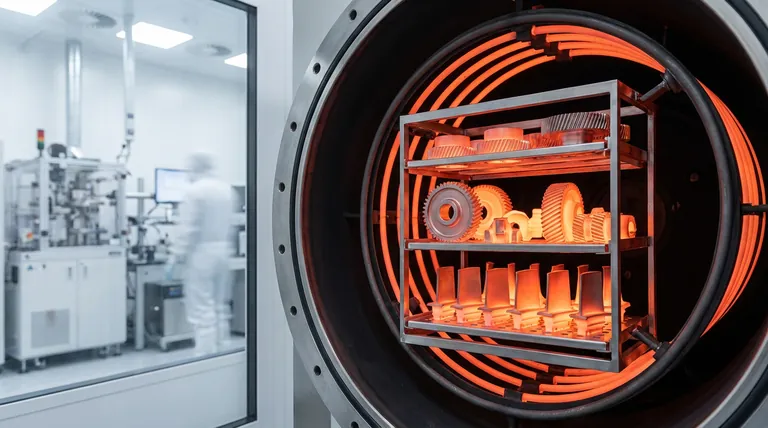
In a vacuum, heat is transferred primarily through radiation. Energy travels in a direct line from the heating element to the part. This results in exceptionally uniform temperature distribution across the entire workload, even for parts with complex geometries. Every surface receives the same thermal energy, ensuring consistent and predictable results.
The Certainty of Automation
This highly controlled environment is a perfect canvas for automation. Without the variable of atmospheric interference, computer-controlled processes can manage heating ramps, soak times, and quenching with absolute precision.
This level of control makes complex, multi-stage treatments perfectly repeatable. It shifts the process from an art reliant on operator skill to a science that delivers identical results, batch after batch. This is the psychology of manufacturing at its best: the elimination of doubt.
The Inescapable Logic of Trade-offs
A vacuum furnace is a specialized instrument, and its power comes with specific considerations. The choice to use one is a conscious investment in control.
| Aspect | Atmospheric Furnace (The Standard) | Vacuum Furnace (The Specialist) |
|---|---|---|
| Environment | Reactive air or controlled gas | Ultra-clean, non-reactive vacuum |
| Control | Good, but subject to convection | Exceptional, driven by radiation |
| Outcome | Prone to surface oxidation (scale) | Bright, clean, oxide-free finish |
| Investment | Lower initial cost, simpler setup | Higher initial cost, complex infrastructure |
| Best For | Simple hardening, non-critical parts | High-purity, critical applications |
The higher capital cost and longer cycle times (due to the initial pump-down) are not flaws. They are the price of certainty. You are paying to remove variables that could compromise the final product.
A Framework for Choosing Your Tool
The decision is not about which furnace is "better," but which is right for your objective.
- For ultimate material purity and performance—in aerospace, medical, or advanced electronics—the clean, non-reactive environment of a vacuum furnace is the only logical choice.
- For brazing complex assemblies, especially with dissimilar metals, the oxide-free surface created in a vacuum is essential for achieving strong, clean, and reliable joints.
- For simple hardening or tempering of non-critical parts, where a bit of surface scale is acceptable and speed is paramount, an atmospheric furnace is often the more practical, cost-effective solution.
Ultimately, choosing a vacuum furnace is a statement about your priorities. It's a commitment to process control and a belief that removing chance is the surest path to perfection.
For laboratories and research facilities where process control is paramount and results are non-negotiable, the right equipment is the foundation of success. KINTEK provides high-performance vacuum furnaces designed for applications that demand this level of metallurgical purity and repeatability.
If you are ready to master your material transformation process, Contact Our Experts.
دليل مرئي
المنتجات ذات الصلة
- فرن الضغط الساخن بالفراغ آلة الضغط الساخن بالفراغ فرن الأنبوب
- فرن الضغط الساخن بالحث الفراغي 600 طن للمعالجة الحرارية والتلبيد
- آلة فرن الضغط الساخن بالفراغ مكبس الضغط الساخن بالفراغ
- فرن معالجة حرارية بالفراغ وفرن صهر بالحث المغناطيسي
- فرن معالجة حرارية وتلبيد التنجستن بالفراغ بدرجة حرارة 2200 درجة مئوية